AI Detection 'Journalism' Slop? The Music Industry's Biggest AI Statistic May Rest on a Black Box
One of the most widely repeated statistics in the music industry today is that nearly half of all new music uploaded to Deezer is AI-generated.
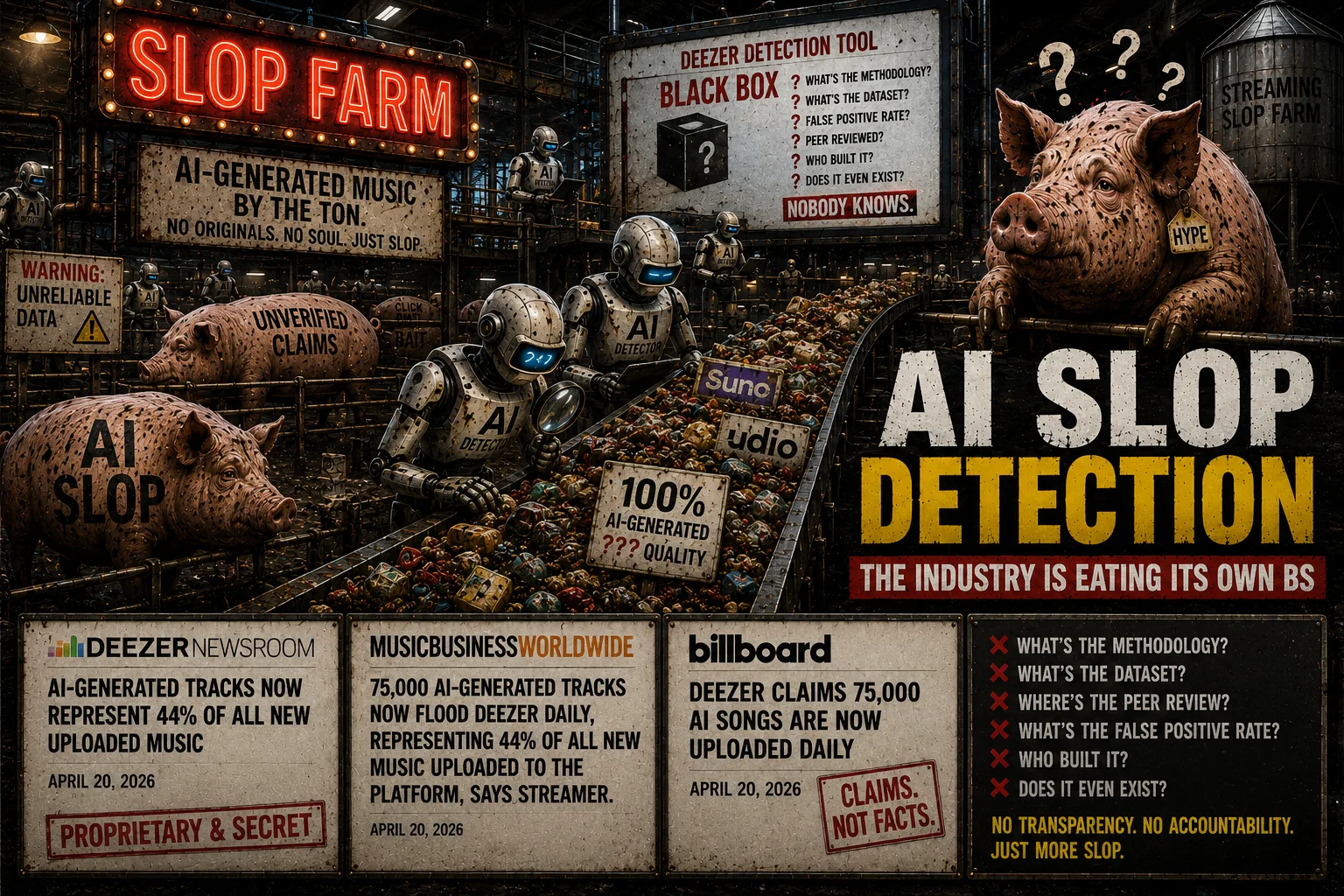
The number has appeared across industry publications, blogs, newsletters, podcasts, social media posts, conference panels, and countless discussions about the future of music. According to a recent announcement from Deezer, the company is now receiving nearly 75,000 fully AI-generated tracks per day, representing approximately 44% of all daily uploads. The figure was quickly amplified by publications including Music Business Worldwide and Billboard.
Yet the most important question remains the simplest one:
How does Deezer know?
That question may sound obvious, but it has often been secondary in coverage surrounding these claims. The discussion has focused heavily on the implications of the numbers, while the evidence, methodology, incentives, and limits behind them have received far less attention.
To Billboard's credit, its reporting has described the figures as Deezer's claims rather than presenting them as independently verified facts. That distinction matters. A claim is something asserted. A fact is something demonstrated. Deezer may ultimately be right, but the public still has reason to ask how much of this conclusion depends on trust in a proprietary system.
Deezer has not been silent about its approach. The company says it uses a patent-pending AI-music detection tool launched in early 2025. It has said the technology can detect music generated by systems such as Suno and Udio and can be adapted to identify content from other tools when relevant training examples are available. Deezer has also filed patents, published creator-facing guidance, made its detection technology available commercially, and supported research into the technical artifacts that may appear in AI-generated music.
That makes Deezer more forthcoming than many companies operating in the AI-detection space.
But transparency is not the same thing as independent verification.
A research paper connected to Deezer's work, A Fourier Explanation of AI-music Artifacts, has been listed in the ISMIR 2025 program and presents a technical explanation for how certain AI-generated music can leave detectable frequency artifacts. The paper argues that some generative model architectures may create systematic spectral peaks that can be used to distinguish synthetic music from human-made recordings. That is meaningful research, and it should not be dismissed casually.
That distinction becomes even clearer in Deezer's own public GitHub materials for earlier AI-music detection research. The repository states that the available code is connected to the ICASSP 2025 paper AI-Generated Music Detection and its Challenges, but also clarifies that the tool in the repository is not the same tool Deezer uses in production for synthetic music detection. That matters. Public research can demonstrate technical seriousness, but it does not fully reveal how the live platform system works, how it performs at scale, or how edge cases are handled when real artists and catalogs are affected.
At the same time, the paper does not prove that every real-world Deezer classification is correct. It does not eliminate the possibility of false positives. It does not answer every question about hybrid works, new model architectures, manipulated audio, edge cases, appeals, or the commercial incentives surrounding AI detection. The authors themselves note that AI-detection systems can be opaque and privately controlled, mirroring some of the same concerns raised about generative AI systems.
That is where the public conversation should become more careful.
There is a difference between saying AI-generated music can often be detected and saying a private platform's large-scale tagging decisions should be accepted without outside scrutiny. There is also a difference between a detector performing well in research conditions and a detector being used as an industry gatekeeping system affecting real artists, distributors, catalogs, and revenue.
What remains unclear is not whether Deezer has evidence. It appears to have evidence. The better question is whether the public, artists, distributors, and journalists have enough information to evaluate that evidence independently.
How often does the system produce false positives in production? How often does it miss AI-generated tracks? How often are labels reversed after review? Does performance vary by genre? Could ambient music, stock music, loop-based music, meditation music, experimental electronic music, or heavily processed instrumental tracks be more vulnerable to misclassification? How does Deezer distinguish between fully AI-generated music and music that merely uses AI-assisted tools during production?
These are not hostile questions. They are basic accountability questions.
The distinction matters because labels carry consequences. Deezer has said AI-generated tracks can be excluded from algorithmic recommendations and editorial playlists. The company has also said it does not store high-resolution versions of AI-detected tracks and that a large portion of streams on AI-generated tracks are considered fraudulent and demonetized. Even if these policies are aimed at spam and manipulation, the stakes are obvious: classification can affect visibility, platform treatment, and money.
If a detection system is going to influence discoverability, monetization, visibility, and catalog handling, then its accuracy should not be treated as a secondary concern.
Imagine if a pharmaceutical company announced that 44% of patients suffered from a previously unknown condition based on an internal proprietary diagnostic tool. Journalists would immediately ask about validation studies, outside reviews, methodology disclosures, false positives, false negatives, incentives, and expert commentary. They would not simply repeat the figure and move on.
Yet when Deezer claims that 44% of new uploads are fully AI-generated, much of the public conversation quickly shifts to what the number means for the future of music before fully examining how the number was produced.
The irony is difficult to ignore. Much of the music industry remains deeply skeptical of artificial intelligence. Yet when an AI-powered detection system produces dramatic numbers that support a preferred narrative, skepticism can become selective.
That does not mean Deezer is wrong. It means the same evidentiary standards applied to AI generation should also be applied to AI detection.
AI detectors are not magical truth machines. They are systems that make judgments based on patterns. They can be powerful. They can be useful. They can also make mistakes. They can be vulnerable to changes in model architecture, new generation techniques, audio processing, adversarial manipulation, and edge cases that do not fit neatly into training data.
The technology industry has a long history of overestimating the reliability of automated detection systems. Copyright bots have incorrectly flagged lawful content. Content ID systems have generated false claims. Spam filters have misclassified legitimate communications. Automated moderation tools have removed harmless material while allowing harmful content to remain.
Why should AI music detection be presumed immune from these challenges?
The issue becomes even more complicated when considering the modern reality of music production. Today's musicians increasingly use AI-assisted tools throughout the creative process. Producers use AI mastering systems. Engineers use AI stem separation. Songwriters experiment with AI-assisted composition tools. Vocalists rely on advanced processing technologies that blur the line between traditional production and machine assistance.
Where exactly does Deezer draw the line between human-created music, AI-assisted music, and fully AI-generated music?
Deezer has offered some public guidance, but the industry still needs clearer answers. A song made entirely from a prompt is one thing. A human-written track mastered with AI tools is another. Between those poles are countless hybrid workflows that are becoming more common every month.
That gray area is where policy, technology, and fairness collide.
Even the language surrounding these discussions deserves scrutiny. Terms such as "AI slop" have become increasingly common in music industry commentary. The phrase carries an implicit assumption that the classification is obvious, objective, and culturally worthless. But if the underlying system remains partially opaque, then confidence in the label may exceed confidence in the evidence available to the public.
Again, this does not mean Deezer is acting in bad faith.
Deezer may be directionally correct. AI-generated music may indeed be increasing rapidly. Its detector may be highly accurate. Its research may be sound. Its policies may be a reasonable attempt to protect artists, listeners, and royalty pools from spam and fraud.
But the company also has incentives. Deezer benefits from being seen as a leader in AI detection. It benefits from licensing its technology. It benefits from presenting itself as a defender of human artists. None of those incentives automatically invalidate its claims, but they do mean the claims deserve scrutiny rather than automatic acceptance.
Extraordinary claims require extraordinary evidence.
Right now, the public conversation is somewhere between evidence and trust. Deezer has provided more than a press release, but less than full independent transparency. That is exactly the zone where journalists should ask harder questions, not fewer of them.
The music industry frequently warns about AI-generated misinformation. It may be worth applying the same level of scrutiny to AI-generated classifications.
Before millions of songs are labeled, filtered, deprioritized, demonetized, or excluded based on AI detection systems, the industry should ask for something surprisingly simple:
The receipts.
Not because Deezer is necessarily wrong. But because the future of music should not be shaped by proprietary detection systems that everyone cites and few people fully understand.