Library of Congress Acquires Rare Music Manuscript Written During Historic Antarctic Expedition
The Library of Congress has acquired a remarkable 19th-century music manuscript containing songs written aboard one of America's most important exploration voyages, preserving what historians believe are the earliest known examples of music and poetry inspired directly by encounters with Antarctica.
According to a recent announcement from the Library of Congress, the manuscript was created during the legendary United States Exploring Expedition of 1838-1842, a scientific and naval mission led by U.S. Navy Lt. Charles Wilkes. The expedition mapped approximately 1,500 miles of Antarctica's eastern coastline and helped establish for the first time that Antarctica was a continental landmass rather than a collection of isolated islands.
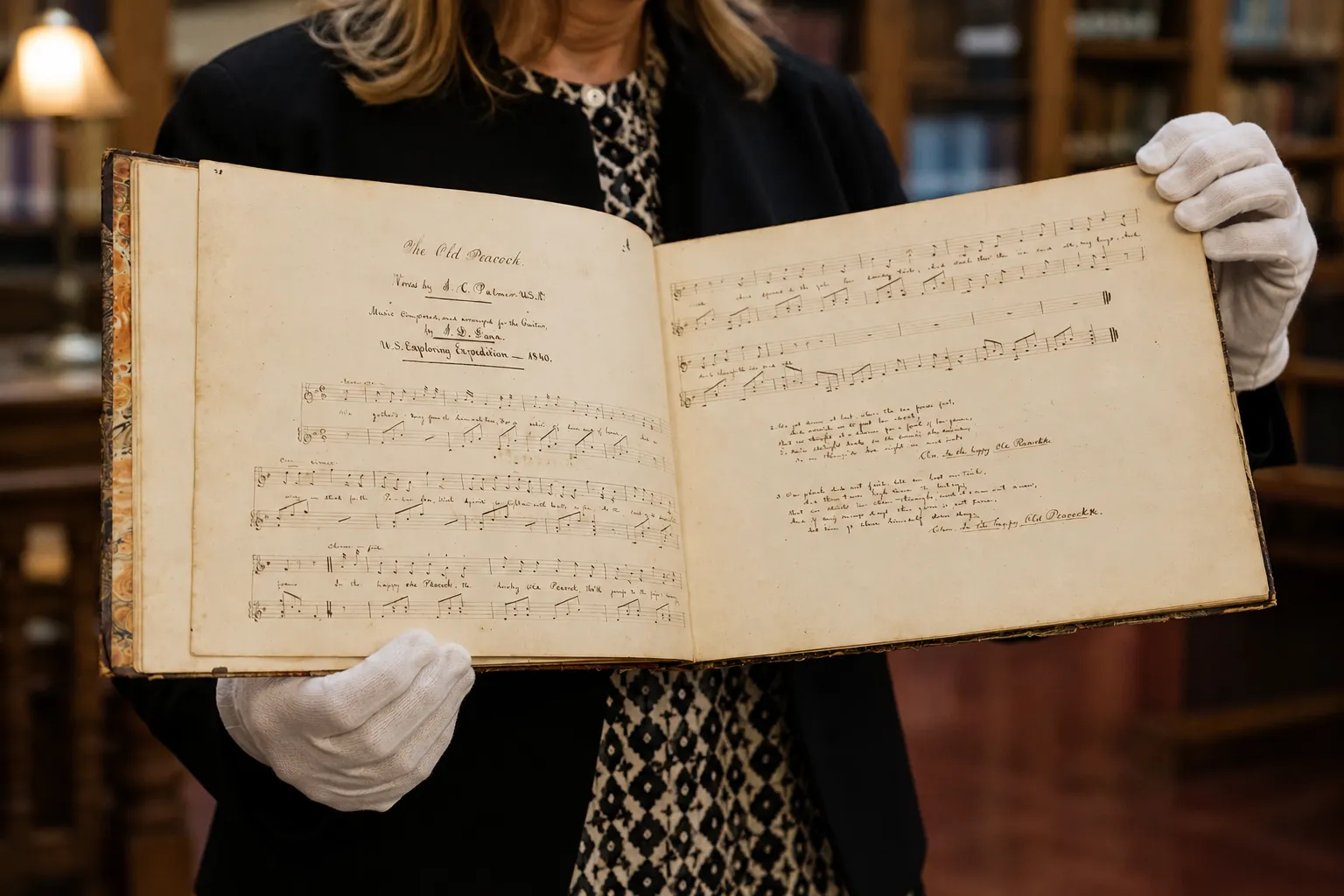
The newly acquired manuscript, titled The Nativity and Other Compositions, was handwritten by geologist and mineralogist James Dwight Dana, one of nine scientists who participated in the expedition. Dana composed music and guitar accompaniments for several songs using lyrics written by expedition surgeon James Croxall Palmer. The works were created while the men were sailing through some of the most remote regions of the Pacific Ocean and Antarctic waters.
While the Wilkes Expedition is primarily remembered for its scientific discoveries, the manuscript offers a rare glimpse into the personal and creative lives of those aboard the ships. Long before recorded music existed, expedition members turned to songwriting and poetry as a way to document their experiences, reflect on their surroundings, and maintain morale during years at sea.
The collection includes several historically significant compositions. Among them is Antarctic Mariner's Song, derived from Palmer's larger narrative poem Thulia: A Tale of the Antarctic, which chronicled the expedition's travels through the polar south. Historians believe the song and related poems represent the earliest known musical works directly inspired by firsthand experiences in Antarctica.
Another composition, The Old Peacock, commemorates the U.S.S. Peacock, one of the expedition's six vessels. The ship was ultimately wrecked at the mouth of the Columbia River in present-day Oregon in 1841. Dana himself was aboard the vessel when it ran aground and was among those rescued.
The manuscript also documents cultural encounters during the expedition. One song, My Tent Beside the Oregon, incorporates melodies identified by Dana as originating from Indigenous communities in the Pacific Northwest, including Chinook and Chehalis musical traditions. The work provides a rare example of how American explorers encountered and documented Native music during the early nineteenth century.
Additional pieces include David's Complaint, a religious composition featuring parts written for both a bass soloist and a chorus, and Young Shepherds' Canzonet, a lighter vocal work arranged for three voices. The volume also contains guitar arrangements of Scottish folk songs and adaptations of European compositions, illustrating the diverse musical influences that accompanied the explorers on their voyage.
The manuscript joins a substantial collection of Wilkes Expedition materials already housed at the Library of Congress, including the Charles Wilkes Papers, Dana Family Papers, rare books, maps, atlases, charts, and photographs documenting the journey and its participants. Together, these materials provide one of the most comprehensive archives of the expedition anywhere in the world.
Senior Music Specialist Raymond A. White described the acquisition as an important addition to the Library's collection of musical Americana. The manuscript is particularly notable because both Dana and Palmer achieved prominence in science and medicine rather than music, making the surviving compositions an unusual intersection of exploration, scholarship, and artistic expression.
The surviving manuscript contains 31 pages and is bound as a book. Researchers believe it originally consisted of 56 pages before portions were removed by previous owners at some point during its nearly two-century history. Some of the missing pages may have contained the title composition, The Nativity, from which the manuscript takes its name.
More than 180 years after the songs were written aboard ships exploring some of the world's least understood regions, the manuscript now has a permanent home where historians, musicians, and researchers can study a unique artistic record of one of America's greatest scientific expeditions. Its acquisition serves as a reminder that exploration often inspires not only discovery, but creativity as well.