Did the Music Industry Accidentally Turn Website Names Into Entire Sentences? A Deep Investigation Into DigitalMusicNews.com, MusicBusinessWorldwide.com, and the Great Domain Length Experiment
Somewhere along the way, the music industry made a fascinating branding decision.
While technology companies launched sleek names like Spotify, TikTok, Apple Music, Pandora, Napster, and Shazam, portions of the music journalism world quietly traveled in the exact opposite direction.
Rather than shorter brands, cleaner identities, or mysterious one-word concepts, an alternate movement emerged:
Long.
Very long.
Suspiciously descriptive domain names.
Not just descriptive.
Names that sounded like someone fed search engine keywords directly into a blender and registered whatever came out.
Examples?
And to be clear: both are respected publications. Both regularly break important stories. Both became essential reading across labels, management companies, artists, distributors, and executives.
But let us pause for a moment and ask an important scientific question:
At what point does a domain stop being a brand and start becoming a paragraph?
Because "Music Business Worldwide" is not merely a publication title.
It sounds like the category you select while filing taxes.
Imagine introducing yourself at a party.
"Hey, where do you work?"
"I write for Music Business Worldwide."
"...Music business worldwide what?"
"No. That's all of it."
"Oh."
Conversation over.
To be fair, context matters.
These sites largely emerged from an earlier internet era. Search engines behaved differently. Exact-match domains once carried tremendous ranking advantages. Domain naming often operated under one simple philosophy:
Tell Google exactly what you are before Google even asks.
No ambiguity.
No artistic mystery.
No brand consultant pacing around a conference room talking about "emotional identity resonance."
Just blunt force clarity.
Digital.
Music.
News.
Three nouns enter.
A company emerges.
The result almost feels beautifully honest.
Nobody clicks Digital Music News wondering whether they accidentally landed on gardening content.
Mission accomplished.
Meanwhile, Music Business Worldwide somehow managed to capture not only an industry but potentially the entire planet in its title.
Not local.
Not national.
Worldwide.
The confidence deserves respect.
But then something interesting happened elsewhere in media.
Brands began moving toward shorter identities.
Consider Rolling Stone.
Rolling Stone tells you absolutely nothing about music news.
It could theoretically be geology coverage.
Outdoor recreation.
Archaeology.
Ancient boulder reviews.
Instead, decades of branding transformed it into one of music journalism's most recognized names.
The title itself became larger than the category.
Likewise, sites like Pitchfork, Billboard, NME, Stereogum, and Consequence embraced names with personality rather than keyword overload.
No one named a publication:
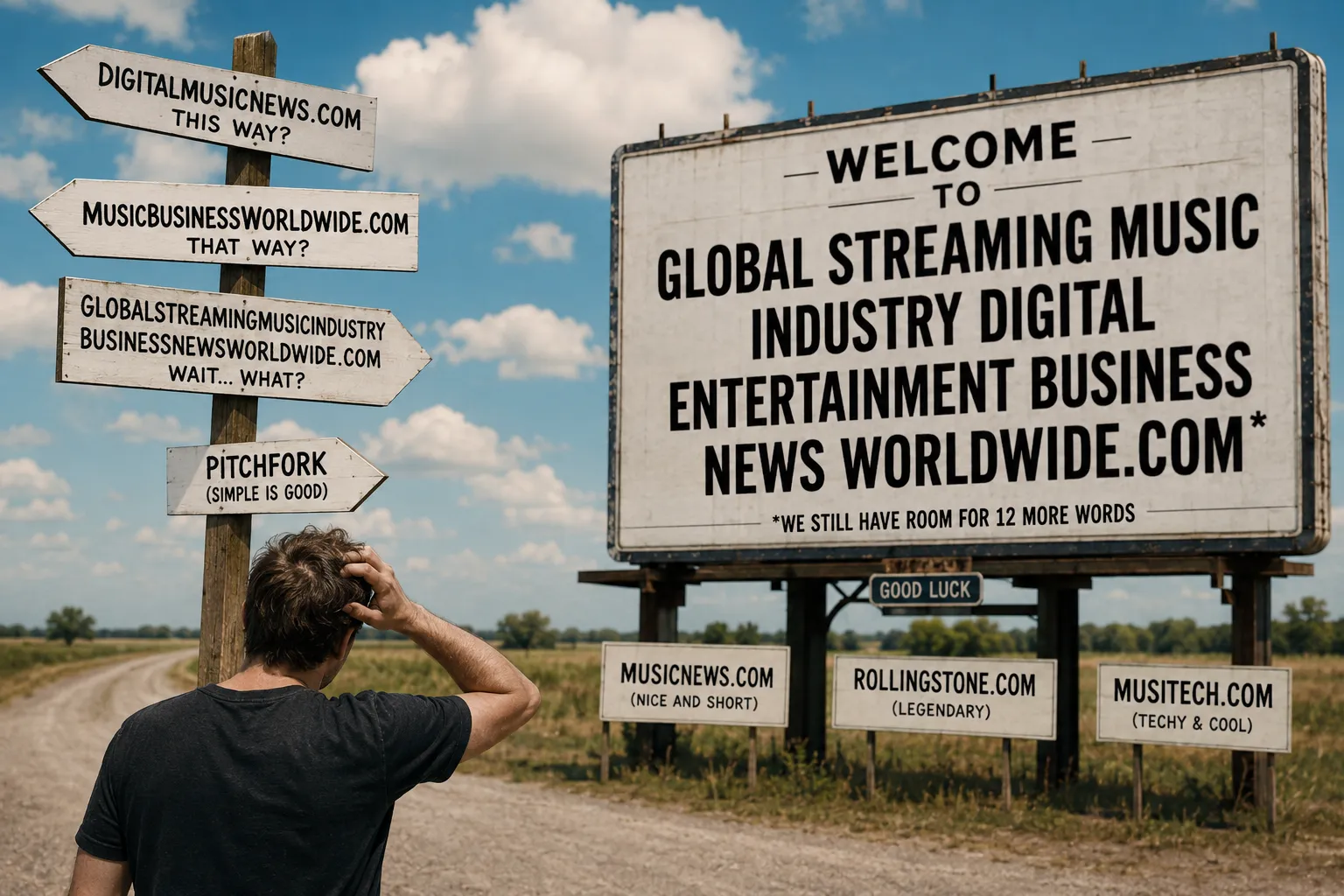
RockMusicArtistIndustryNewsDailyOnline.com
At least not publicly.
Then there are modern hybrid examples.
Sites attempting to blend direct meaning with stronger branding.
Take MusicNews.com.
Now that becomes an interesting case study.
Because unlike "Music Business Worldwide," it feels shorter, cleaner, and more direct while still maintaining category recognition.
Two words.
Simple.
Memorable.
Easy to say.
Easy to remember.
No one needs to take a breath midway through pronunciation.
Similarly, platforms such as MusicTech attempted balancing technology and music culture with more compact naming approaches.
Suddenly names begin functioning like brands again rather than sounding like autocomplete suggestions.
Which raises a larger question:
Did long music-industry domains actually work?
The uncomfortable answer is:
Yes.
Absolutely.
Possibly annoyingly well.
Because while branding experts often argue that shorter names create stronger identities, exact-match and descriptive domains historically produced substantial SEO advantages.
Readers immediately understood content categories.
Search engines understood categories.
Advertisers understood categories.
Everyone understood categories.
There was almost zero friction.
And early internet success often depended on reducing friction wherever possible.
You clicked.
You arrived.
You knew exactly where you were.
End of process.
Perhaps modern startup culture spoiled everyone slightly.
Today companies desperately chase invented words:
Spotify.
Tumblr.
Reddit.
TikTok.
Lyft.
Shazam.
Meanwhile older media brands looked at that trend and effectively said:
"No."
"We shall simply explain ourselves."
And maybe there is something wonderfully unpretentious about that.
Because branding occasionally becomes obsessed with cleverness.
The music industry, for a brief window, chose utility.
Aggressive utility.
Possibly absurd utility.
Yet it worked.
And honestly, history may remember these names fondly.
Because long after trends disappear, there remains something charming about publications whose branding philosophy essentially translated to:
"Let's just tell people exactly what we do and go home."
Though if somebody launches:
GlobalStreamingMusicIndustryArtificialIntelligenceDigitalEntertainmentBusinessNewsWorldwide.com
...it may finally be time for intervention.