From New Orleans to the Cosmos: The Wild, Revolutionary History of Jazz Music
Few musical genres changed culture the way jazz did. Rock transformed youth culture. Hip-hop reshaped global expression. Electronic music reinvented production. But jazz did something larger: it rewired the DNA of modern music itself. Nearly every major genre that followed carries traces of its influence. Jazz was rebellion, innovation, improvisation, and experimentation all at once. It was music that often refused to sit still.
Its story begins not in grand concert halls or elite institutions, but in neighborhoods alive with noise, collision, migration, and invention.
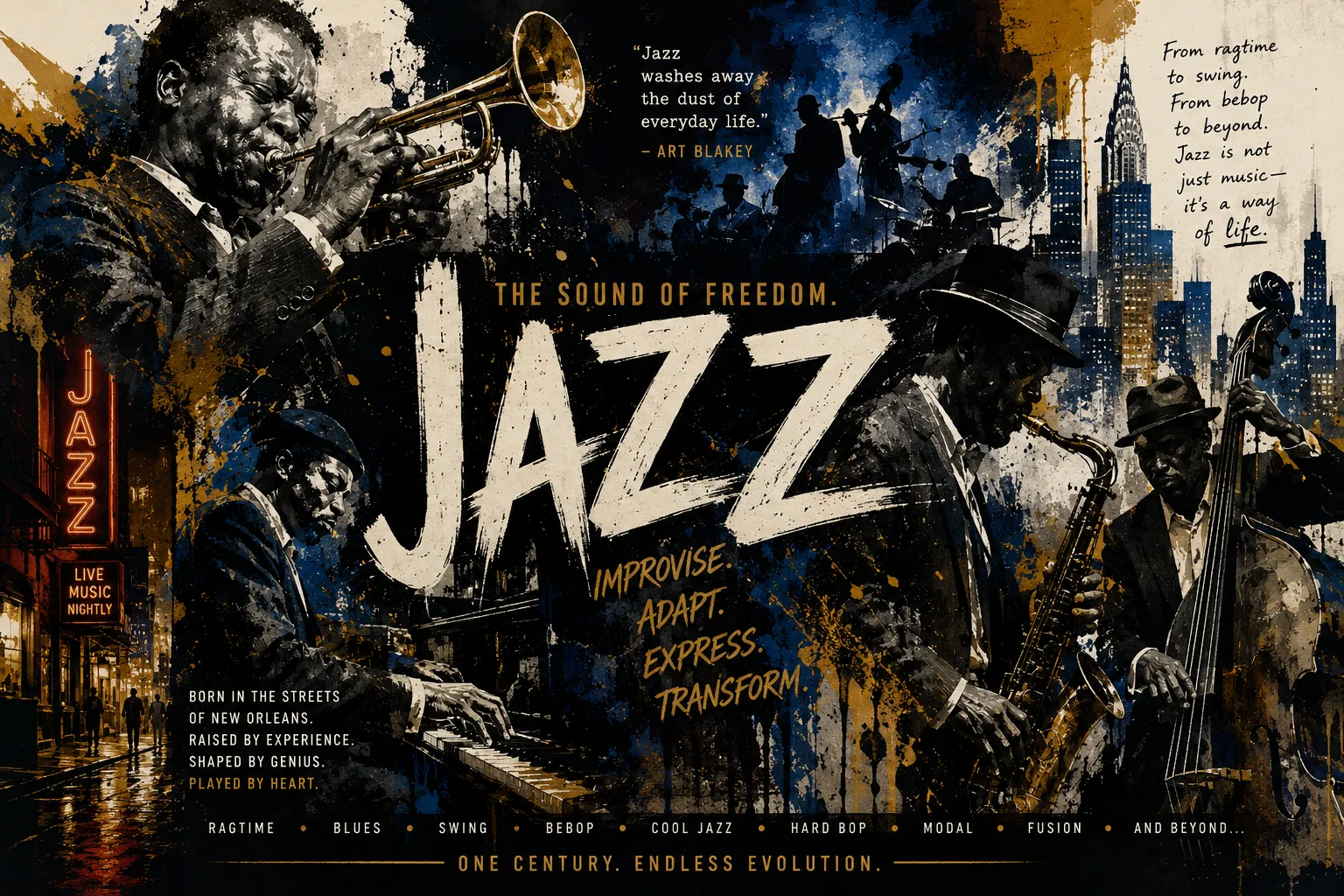
Jazz emerged in the late 19th and early 20th centuries in New Orleans, one of America's most culturally unique cities. New Orleans was a place where African rhythms, blues traditions, church music, ragtime piano, military brass bands, folk music, Caribbean sounds, and European musical structures all collided in real time. Rather than existing separately, these influences blended into something entirely new.
The city itself almost functioned like a laboratory.
Street parades moved through neighborhoods accompanied by brass bands. Churches filled communities with gospel traditions. Dance halls pulsed with ragtime and blues. Musicians borrowed from one another constantly. Formal musical rules mattered less than energy and feeling.
Among the earliest major figures was Buddy Bolden, often credited as one of jazz's first true innovators. Although no recordings of Bolden survive, stories surrounding his playing became legendary. Accounts described a louder, looser, more expressive sound unlike anything audiences had heard before.
Soon, musicians began pushing those ideas even further.
In the early decades of the twentieth century, jazz spread northward as part of broader migration patterns. Cities like Chicago and New York City became new centers of musical development. The movement of musicians transformed jazz from a regional style into a national force.
Then came one of the most important figures in music history: Louis Armstrong.
Armstrong did not simply play jazz; he redefined its possibilities. His trumpet style transformed solo performance and improvisation. Before Armstrong, ensemble playing often dominated early jazz. Armstrong shifted attention toward individual expression, creating performances filled with personality and technical brilliance.
His influence stretched far beyond jazz itself.
Nearly every modern concept surrounding musical individuality can trace some lineage back to Armstrong.
By the 1930s and 1940s, jazz entered what became known as the Swing Era.
Big bands exploded in popularity. Dance halls filled nightly. Massive ensembles featuring brass sections, rhythm players, and carefully arranged compositions dominated radio and live performance. Artists including Duke Ellington, Count Basie, and Benny Goodman became household names.
Jazz had become America's popular music.
But jazz rarely stays comfortable.
By the 1940s, younger musicians wanted greater complexity and freedom. They grew frustrated with predictable dance arrangements and sought new territory.
That led to bebop.
If swing invited listeners onto the dance floor, bebop demanded attention.
Figures including Charlie Parker and Dizzy Gillespie transformed jazz into something more challenging, faster, and intellectually adventurous. Songs featured rapid chord changes, unusual phrasing, and improvisational complexity that stunned audiences.
Bebop became music designed less for dancers and more for musicians.
And once again, jazz evolved.
The following decades produced an explosion of new directions.
Cool jazz introduced smoother, more restrained textures through artists like Miles Davis and Chet Baker.
Hard bop brought blues and gospel influences back into the music.
Modal jazz explored new harmonic structures.
Avant-garde and free jazz shattered traditional expectations entirely.
Few artists represented jazz's constant reinvention better than Miles Davis. Across multiple decades, Davis repeatedly transformed his style rather than repeating earlier successes. Albums such as Kind of Blue became landmarks not simply because of technical brilliance, but because they expanded ideas surrounding atmosphere, improvisation, and musical space.
Then came fusion.
During the late 1960s and 1970s, jazz collided with rock, funk, and electric experimentation. Artists including Herbie Hancock and groups like Weather Report helped build entirely new sonic landscapes.
Purists argued.
Fans debated.
Jazz kept moving.
Its influence meanwhile expanded almost everywhere.
Hip-hop producers sampled jazz records heavily. Neo-soul borrowed its harmonic complexity. Electronic artists adapted its textures and improvisational spirit. Film scores leaned on jazz mood and atmosphere. Modern producers across pop, R&B, and experimental music regularly pull from its vocabulary.
Even artists who never consciously study jazz often absorb ideas it introduced decades earlier.
Perhaps that explains jazz's enduring power.
Unlike many genres, jazz was never designed around fixed rules. It was built around adaptation itself. Improvisation sits at its core — not simply as a musical technique but almost as a philosophy.
Listen.
Respond.
Experiment.
Change.
Those ideas remain timeless.
Today, jazz continues evolving across clubs, streaming platforms, universities, underground scenes, and digital communities around the world. New artists constantly reinterpret the form while reshaping what jazz can become.
More than a century after its beginnings in New Orleans streets, jazz still refuses to stand still.
Maybe that was always the point.