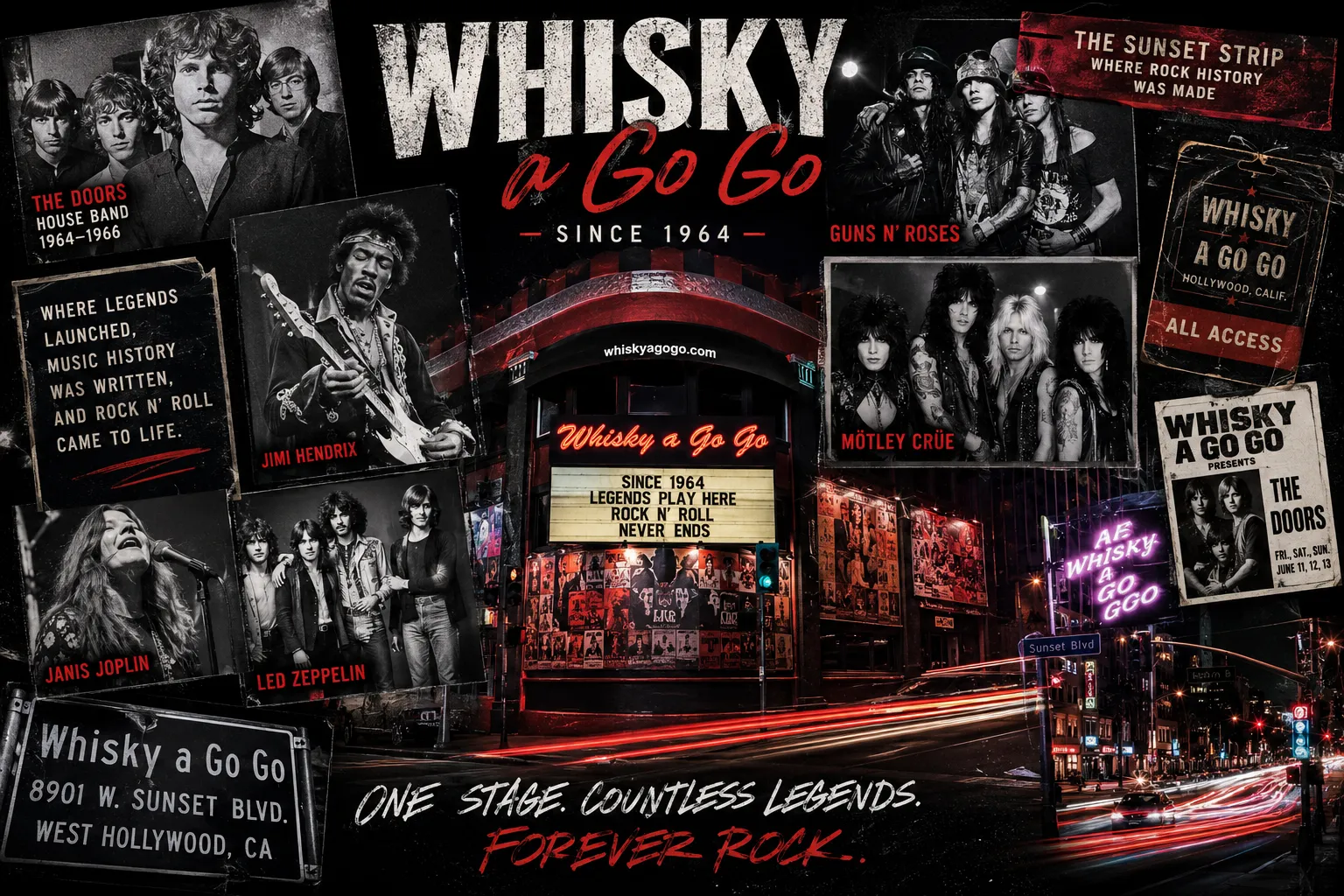
The Whiskey That Built Rock: The Wild History of the Whisky a Go Go
Long before viral moments, streaming playlists, or algorithm-driven discovery, there were clubs. Small rooms. Loud amplifiers. Cigarette smoke. Packed crowds. Places where entire music movements could emerge in a single night.
Few venues embody that history quite like the legendary Whisky a Go Go.
More than a concert venue, the Whisky became a launchpad, a proving ground, and eventually one of the most important addresses in rock history. Over six decades, nearly every era of modern music has crashed through its doors.
Its story begins in the early 1960s on the rapidly evolving Sunset Strip.
The Whisky a Go Go officially opened on January 16, 1964, in West Hollywood. The club's concept borrowed inspiration from fashionable Parisian discotheques where music, dancing, and nightlife collided into immersive experiences. The phrase "à gogo" itself loosely translated to something like "in abundance" or "galore," fitting for an era defined by explosive youth culture. The club quickly distinguished itself from traditional venues by featuring elevated dance cages and dancers known as "go-go girls" — a visual style that soon spread across America. The Whisky didn't simply follow trends; it accidentally created them.
Almost immediately, major artists began appearing.
Among the earliest acts were Johnny Rivers, whose residency became a major success and helped establish the club's reputation. Audiences packed the venue nightly. Soon the Whisky became one of the hottest destinations on the Sunset Strip.
Then things escalated.
By the mid-1960s, British invasion acts and emerging American bands turned the venue into sacred ground. The Doors became deeply connected to the club's mythology. Before becoming one of rock's defining acts, they served as the house band.
Then came one of the most famous firings in music history.
After a performance of The End reportedly included an improvised section by Jim Morrison that alarmed venue management, the band was dismissed. Instead of ending their momentum, the incident became part of rock legend. Months later, The Doors signed with a major label and entered a trajectory that would permanently alter music history.
The venue became increasingly central to the cultural explosion unfolding around Los Angeles.
Artists including Jimi Hendrix, Janis Joplin, Led Zeppelin, The Byrds, and Cream all played the Whisky stage.
The club wasn't simply hosting concerts.
It was documenting the evolution of rock in real time.
Then came the 1970s.
Hard rock grew heavier. Audiences became louder. Musical identities shifted again. The Whisky adapted.
Punk exploded.
Metal followed.
Entirely new scenes emerged.
By the late 1970s and into the 1980s, the Sunset Strip transformed into a center of glam metal and hard rock culture. Bands arrived with teased hair, leather jackets, and dreams of stardom. The Whisky became a critical proving ground for young acts trying to build audiences.
Groups including Mötley Crüe, Guns N' Roses, Poison, and W.A.S.P. either played there or emerged from the surrounding Strip ecosystem.
Night after night, record executives wandered through crowds searching for the next breakout act.
Sometimes they found one.
Sometimes they found several.
What made the Whisky unusual was its ability to survive multiple musical extinctions. Scenes rose and collapsed around it. Disco faded. Glam dissolved. Grunge arrived. Hip-hop transformed culture. Streaming reshaped music itself.
The Whisky remained.
Over time, artists from entirely different generations continued stepping onto its stage. New bands played the same room once occupied by Hendrix and Morrison. Young musicians stood where legends once stood.
That continuity matters.
Because venues like the Whisky preserve something increasingly rare: physical musical history.
Algorithms cannot recreate a room.
Streaming platforms cannot manufacture mythology.
A playlist cannot replace walking onto a stage where decades of chaos, discovery, and music history still linger in the walls.
Today, the Whisky a Go Go remains active on the Sunset Strip — still hosting shows, still introducing audiences to new artists, and still functioning as one of rock's most enduring landmarks.
For a venue born during the Beatles era, that's a remarkable survival story.
And perhaps the greatest sign of its legacy is this:
Every generation still walks through the doors believing they might witness history.