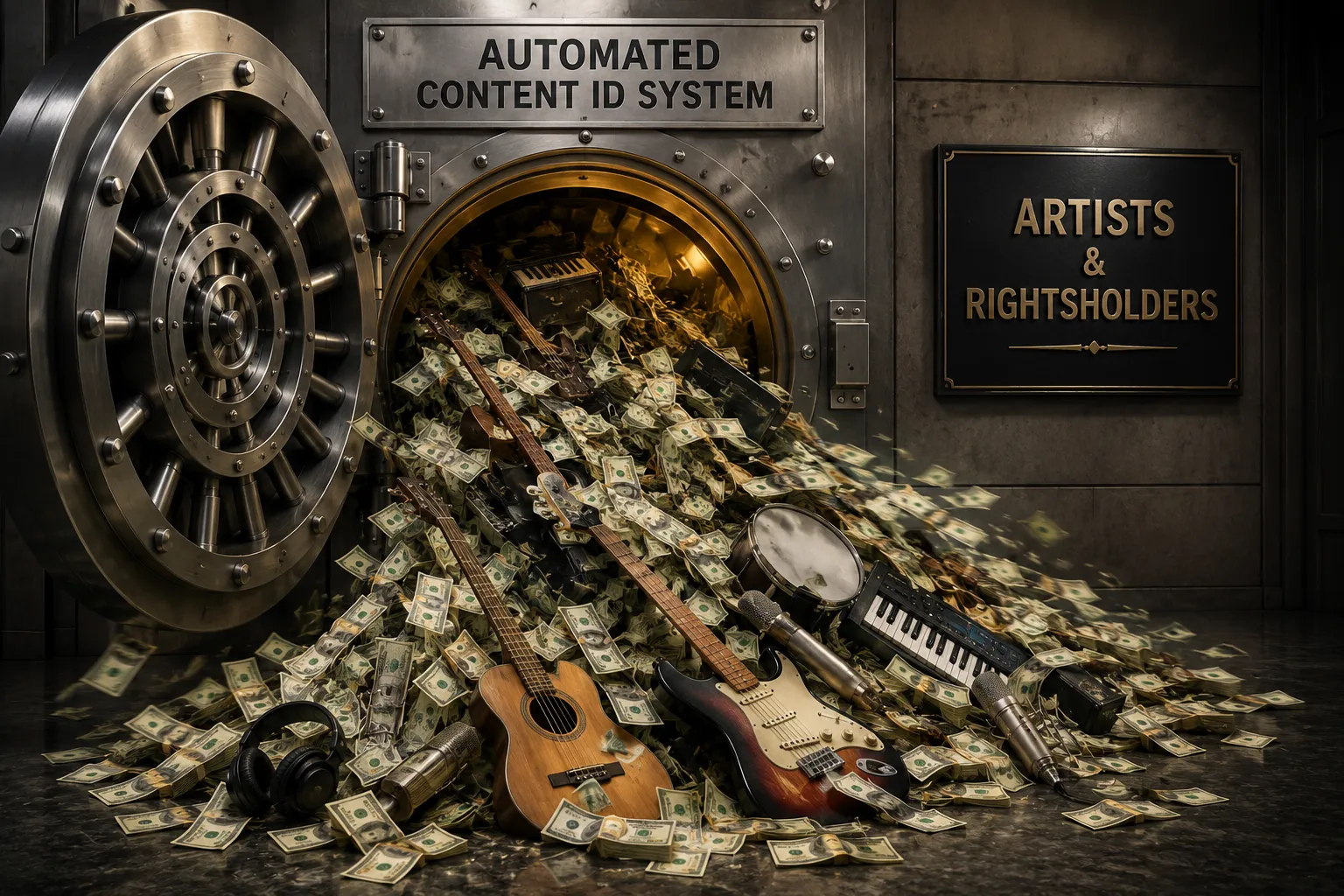
Did Content ID Accidentally Turn Licensed Samples Into a Financial Trap? Artists Are Beginning to Ask Uncomfortable Questions
The modern music business runs on automation.
Songs are uploaded automatically. Royalties are tracked automatically. Copyright ownership gets scanned automatically. Platforms identify audio automatically. Content is matched, monetized, blocked, claimed, distributed, and cataloged at a scale no human workforce could realistically manage.
In theory, that sounds like progress.
In reality, some artists increasingly wonder whether the systems designed to protect creators occasionally create entirely new problems.
Because a growing number of musicians are asking a strange question:
What happens when copyright robots encounter music built from sounds thousands of people legally have the rights to use?
And increasingly, some independent creators think they may already know the answer.
Their theory:
Shared sample libraries, automated fingerprint systems, and Content ID-style technologies may occasionally collide in ways nobody fully anticipated.
The result?
Confusing claims.
Unexpected revenue reversals.
Mysterious financial adjustments.
And in some cases, creators reporting losses reaching thousands of dollars.
To be absolutely clear: there is no publicly established evidence proving licensed sample use itself directly causes large-scale financial penalties or platform clawbacks.
But among independent musicians, producers, and creators, the theory has become difficult to ignore.
Because the math occasionally stops making sense.
The Sample Revolution Changed Music Production
To understand the concern, you first have to understand how modern music is actually made.
For decades, producers built sounds manually from instruments, recordings, synthesizers, and live performances.
Today, however, enormous portions of music production rely on sample ecosystems.
Platforms like Splice, Loopcloud, Arcade, and countless sample marketplaces provide libraries containing:
drum loops
vocal phrases
melodies
bass lines
effects
textures
guitar riffs
percussion loops
cinematic sounds
ambient recordings
Millions of sounds now exist inside these ecosystems.
And importantly:
many are licensed non-exclusively.
Meaning thousands of producers can legally download and use the exact same sounds.
Producer A downloads a vocal loop.
Producer B downloads the identical loop.
Producer C does too.
All perfectly legal.
That model transformed music production.
Hit songs now regularly contain sample-library material.
Independent artists rely on them daily.
Even major chart records increasingly pull sounds from shared ecosystems.
Nobody considered this controversial.
Until automation entered.
Content ID Doesn't Understand Intent
Platforms like YouTube use systems capable of comparing uploaded material against giant databases of reference recordings.
The goal sounds simple:
Find copyrighted material.
Identify ownership.
Pay the correct rights holders.
Protect creators.
But these systems primarily recognize patterns.
Waveforms.
Audio signatures.
Spectral information.
They hear sound.
They do not necessarily understand context.
And context matters enormously.
Imagine this scenario:
Producer A downloads a vocal sample.
Builds a song around it.
Releases the song.
Distributes it through a distributor.
The song enters automated fingerprint systems.
Months later:
Producer B legally uses the same sample.
Different song.
Different arrangement.
Different artist.
Same licensed sound.
Automated systems detect overlap.
Now what?
Humans understand the distinction immediately.
Machines may not.
The system simply knows:
"I've heard this before."
And suddenly creators worry things become messy.
A Few Plays, Thousands of Dollars?
The concern becomes larger when creators describe situations involving major financial adjustments.
Recently, independent artists publicly discussed examples involving large negative balances and revenue reversals linked to social platforms.
Some creators reported seeing accounts swing deeply negative despite claiming certain tracks generated relatively small visible engagement.
Naturally, questions followed.
Because artists looked at play counts and thought:
Wait.
How does this add up?
How do relatively small audience numbers suddenly connect to reversals measured in thousands of dollars?
Platforms possess internal signals users never see:
invalid traffic systems
bot detection
ownership conflicts
fraud prevention systems
duplicate registrations
rights disputes
advertising adjustments
metadata conflicts
Those systems absolutely serve real purposes.
But creators increasingly say transparency becomes difficult when large financial outcomes appear without detailed explanation.
And when documentation feels vague, theories emerge.
The Sample Theory
One theory now circulating across creator communities goes something like this:
What if shared licensed samples accidentally create ownership confusion inside automated systems?
Not because anyone acted maliciously.
Not because creators violated licenses.
Not because platforms intentionally target artists.
Simply because systems designed around uniqueness suddenly encounter sounds that legally appear everywhere.
Thousands of users.
Thousands of songs.
Identical source material.
Machines attempting certainty.
The concern sounds less absurd once stated out loud.
Because Content ID systems were largely designed around identifying ownership.
Sample ecosystems were designed around shared usage.
Those goals occasionally appear to collide.
Producers Have Quietly Worried About This For Years
Among producers, this concern is not entirely new.
Many creators already avoid heavily used vocal samples.
Some avoid prominent melody loops altogether.
Others heavily manipulate source material specifically to avoid future disputes.
Pitch shifting.
Stretching.
Chopping.
Layering.
Reversing.
Resampling.
Not purely for creativity.
Sometimes for survival.
Because creators fear future ownership confusion.
Ironically, producers occasionally modify royalty-free sounds simply to avoid automated systems built to identify sound similarity.
That itself says something important.
The Bigger Problem Might Be Transparency
Maybe shared loops are involved.
Maybe they are not.
Maybe fraud systems trigger reversals.
Maybe ownership conflicts happen.
Maybe metadata creates problems.
Maybe entirely different mechanisms sit behind these situations.
The larger issue increasingly appears to be visibility.
Creators often say they simply want:
documentation
line items
reporting
timestamps
clear explanations
paper trails
Because when automation handles billions of events daily, human understanding becomes harder.
And when artists suddenly see four-digit negative balances attached to music with relatively small audiences, questions naturally follow.
Not conspiracy theories.
Questions.
Reasonable questions.
Because if automated copyright systems increasingly control money, ownership, visibility, and livelihoods…
people eventually want to know how the machines reached their conclusions.
And if shared licensed sounds accidentally became part of that story—
the music industry may have built a problem nobody intended.