A Look Back at Empty Room Systems: The Boutique Plugin Developer That Won Over Audio Engineers
In the world of audio software, some companies become industry giants.
Others become legends through a handful of carefully crafted products.
Empty Room Systems belongs firmly in the second category.
Founded by Dutch developer Harrie Munnik, Empty Room Systems earned a devoted following among audio engineers, producers, and musicians through a small but highly respected collection of plugins designed to faithfully recreate some of the most beloved pieces of vintage studio hardware ever built.
While the company never attempted to compete with larger plugin developers on quantity, it built its reputation through quality. Each release focused on recreating the unique sonic characteristics of classic analog processors that had become staples of recording studios throughout the second half of the twentieth century.
For many producers, Empty Room Systems became one of the hidden gems of the plugin world.
The Rise of Boutique Audio Development
The late 2000s and 2010s saw a major shift in music production.
As computing power increased and digital audio workstations became more sophisticated, musicians increasingly relied on software recreations of expensive hardware that previously could only be found in professional studios.
Developers around the world began tackling legendary compressors, equalizers, reverbs, delays, and modulation units.
What made Empty Room Systems stand out was its attention to detail.
Rather than producing large numbers of products, Harrie Munnik focused on a small collection of carefully modeled effects that emphasized authenticity, musicality, and usability.
The result was a catalog that earned praise from professionals despite remaining relatively small compared to larger competitors.
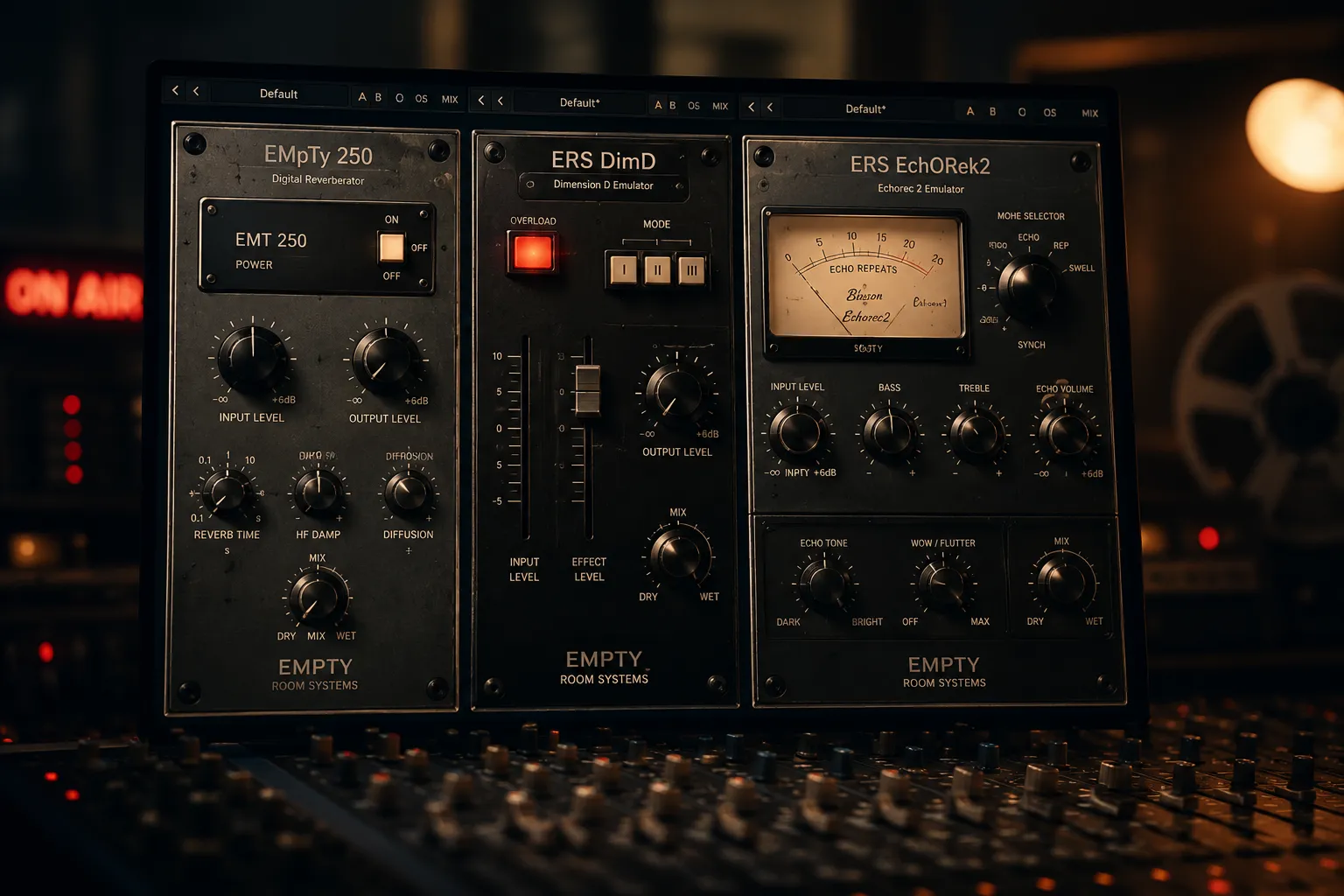
EMpTy 250: Bringing a Reverb Legend Back to Life
Perhaps no plugin better represented Empty Room Systems than EMpTy 250.
The software was designed as a detailed recreation of the legendary EMT 250 Electronic Reverberator, one of the most influential digital reverbs ever created.
Released in the 1970s, the original EMT 250 is often considered the first commercially successful digital reverb. Its distinctive sound appeared on countless recordings and remains highly sought after by engineers decades later.
The problem, of course, is availability.
Original EMT 250 units are exceptionally rare, expensive, and difficult to maintain.
Empty Room Systems sought to bring that sound into the modern digital studio.
The plugin quickly earned praise for capturing the lush modulation, smooth decay characteristics, and transparent spatial quality that made the original hardware famous.
Many users considered it one of the finest EMT 250 emulations available.
The plugin became particularly popular among engineers working in ambient music, film scoring, jazz, acoustic recordings, and high-end mixing environments.
ERS DimD: Recreating a Studio Secret Weapon
Another standout release was ERS DimD.
The plugin modeled the Roland Dimension D, one of the most respected chorus processors ever manufactured.
Unlike traditional chorus effects that produce obvious pitch modulation, the Dimension D became famous for its ability to create width and depth without sounding artificial.
For decades engineers used the hardware on vocals, guitars, synthesizers, strings, drums, and entire mixes.
Its effect was often described as something listeners could feel more than hear.
ERS DimD successfully captured that philosophy.
Rather than producing dramatic modulation effects, the plugin excelled at subtle enhancement. Producers frequently used it to add stereo width, increase perceived depth, and create a polished sense of space.
Its understated approach became one of its greatest strengths.
Many users considered it a secret weapon for mixing.
ERS EchORek2: Reviving the Binson Legacy
Perhaps the most distinctive product in the company's catalog was ERS EchORek2.
The plugin recreated the legendary Binson Echorec 2 disc delay unit.
Originally manufactured in Italy during the 1960s and 1970s, the Echorec occupied a unique place in recording history.
Unlike tape-based delays, the Binson used a rotating magnetic drum system to create echoes.
This design produced a distinctive character featuring subtle saturation, tube coloration, wow, flutter, and rhythmic repeats unlike anything produced by conventional tape echoes.
The Echorec became closely associated with artists such as Pink Floyd, whose guitarist David Gilmour used the hardware extensively throughout the band's classic recordings.
ERS EchORek2 sought to preserve that sound inside modern production environments.
Users praised the plugin's ability to recreate the vintage warmth, evolving modulation, and musical imperfections that defined the original hardware.
For producers seeking classic psychedelic textures, vintage delays, and atmospheric sound design, it became a favorite choice.
A Reputation Built on Sound Quality
One reason Empty Room Systems developed such a loyal following was its commitment to sonic authenticity.
Many plugin developers market products based primarily on visual recreations of hardware.
Empty Room Systems focused heavily on sound.
Users frequently commented on the musical response of the plugins, noting that they felt more like creative instruments than simple effects processors.
The company developed a reputation for products that sounded expensive.
That reputation spread through online forums, recording communities, review sites, and professional studios.
While the company never achieved the mainstream visibility of larger developers, it earned something arguably more valuable: trust.
Engineers knew that when Empty Room Systems released a product, it would likely be worth paying attention to.
The Transition to DDMF
In early 2021, Empty Room Systems officially transitioned its product lineup to DDMF.
The move brought an end to the company's independent era while ensuring that its plugins would continue receiving support, maintenance, updates, and future availability.
Traffic from the Empty Room Systems website was redirected to DDMF, and responsibility for ongoing product development shifted to the German software company.
For existing customers, the transition provided continuity.
For the broader audio community, it ensured that some of the company's most respected products would remain available rather than disappearing entirely.
Such transitions are not uncommon in the software industry, particularly among boutique developers operating in specialized markets.
Still, many longtime users viewed the move as the end of a notable chapter in audio software history.
A Lasting Legacy
Although Empty Room Systems never maintained a massive product catalog, its influence continues through the plugins it created.
EMpTy 250 remains respected among reverb enthusiasts.
ERS DimD continues to serve as a favorite stereo enhancement tool.
ERS EchORek2 remains a popular choice for producers seeking authentic vintage delay textures.
Together, they represent a philosophy that has become increasingly rare in modern software development: fewer products, built with obsessive attention to detail.
In an industry often driven by constant releases and expanding feature lists, Empty Room Systems demonstrated that a small collection of exceptional tools can leave a lasting impression.
Years after the company's transition to DDMF, engineers still discuss its plugins with admiration.
For many audio professionals, Empty Room Systems remains one of the great boutique success stories of the VST era.
Its catalog may have been small.
Its impact was not.