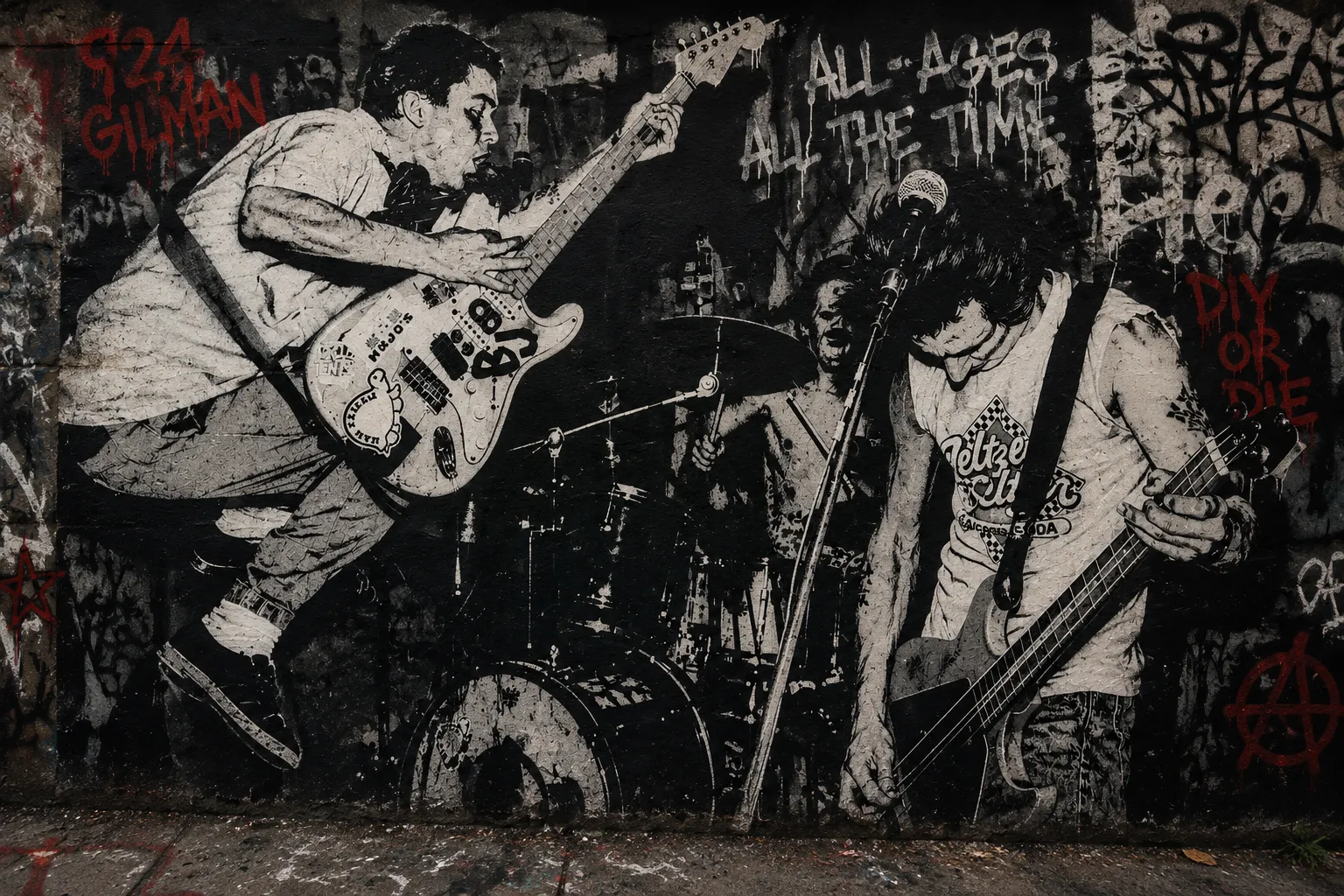
924 Gilman Street: The DIY Punk Club That Changed Music Forever
Few music venues have influenced modern punk rock as profoundly as 924 Gilman Street.
Tucked away in Berkeley, California, the all-ages volunteer-run club became one of the most important underground music venues in American history. What began as a community-driven experiment in the late 1980s evolved into a cultural institution that helped launch bands, define scenes, and shape the future of punk rock.
Unlike traditional music venues, Gilman was built around a philosophy.
The club operated as a nonprofit collective dedicated to creating a safe, all-ages space where artists and fans could participate without corporate influence. Racism, sexism, homophobia, violence, and major-label promotion were prohibited. The venue belonged to the community, and the community fiercely protected it.
That commitment to independence would eventually make Gilman famous far beyond Berkeley.
The Birth of a Punk Institution
924 Gilman Street opened in 1986 during a period when many punk venues across the United States were disappearing. Rising rents, police pressure, and violence had made it increasingly difficult for underground bands to find places to perform.
A group of East Bay punks decided to solve the problem themselves.
The result was Gilman, a venue operated entirely by volunteers. Members cleaned the building, booked shows, sold tickets, handled security, and maintained the space. It was DIY in the purest sense of the term.
Word spread quickly.
Soon Gilman became the epicenter of the East Bay punk scene.
Bands from across California and eventually around the world began making pilgrimages to the venue.
Operation Ivy and the Birth of Ska-Punk
One of the most important bands associated with Gilman was Operation Ivy.
Though their career lasted only a short time, Operation Ivy helped redefine what punk could be. Combining the speed and aggression of hardcore with ska rhythms and socially conscious lyrics, the band created a sound that would influence generations of musicians.
Songs such as "Knowledge," "Sound System," and "Unity" became underground anthems.
The band's lone studio album, *Energy*, remains one of the most influential punk records ever released.
Despite breaking up in 1989, Operation Ivy's impact never faded.
Their members would go on to shape punk rock for decades.
Most notably, vocalist Jesse Michaels became a legendary figure within the Gilman community, while bassist Matt Freeman and guitarist Tim Armstrong would later form one of punk's most successful bands.
Rancid Carries the Torch
After Operation Ivy dissolved, Tim Armstrong and Matt Freeman eventually formed Rancid.
The band carried forward many of Operation Ivy's musical ideas while expanding into street punk, hardcore, ska, and classic rock influences.
Albums such as *...And Out Come the Wolves* helped bring punk rock back into the mainstream during the 1990s.
Even after achieving international success, Rancid maintained strong ties to Gilman and the East Bay scene.
Their story reinforced the venue's growing reputation as a breeding ground for influential artists.
The Rise of Green Day
No band is more closely associated with Gilman than Green Day.
Before becoming one of the biggest rock bands in the world, Billie Joe Armstrong, Mike Dirnt, and drummer John Kiffmeyer were regular participants in the East Bay punk scene.
On May 28, 1989, the band played its first show under the name Green Day at 924 Gilman Street.
At the time they were simply another local punk band trying to earn a following.
Gilman quickly became their home.
The band played countless shows there during the late 1980s and early 1990s, developing a loyal audience and refining the melodic punk style that would eventually make them famous.
Many fans who attended those early performances had no idea they were witnessing the future of one of rock's biggest acts.
Watch: Green Day Live at Gilman in 1991
The footage above captures Green Day during a crucial period of their development.
Recorded on October 20, 1991, the performance took place while the devastating Oakland Hills fire was burning nearby. According to archivist and videographer Arica Pelino, travel disruptions caused by the fire forced unusual detours just to reach the venue.
The video provides a rare glimpse into Green Day before global fame arrived.
The band is raw, energetic, fast, and unmistakably rooted in the East Bay punk tradition.
For fans accustomed to seeing Green Day perform in stadiums, the footage serves as a reminder that every major act starts somewhere.
In Green Day's case, that somewhere was Gilman.
The Major Label Controversy
Everything changed in 1994.
Green Day signed with Reprise Records and released *Dookie*.
The album became a cultural phenomenon.
Songs such as "Basket Case," "Longview," and "When I Come Around" transformed the group into international superstars.
But success came with consequences.
Gilman maintained strict rules against major-label involvement. When Green Day signed their record deal, many members of the community viewed it as a violation of the venue's principles.
The band was effectively banned from performing there.
The experience left a lasting impression on Billie Joe Armstrong.
Green Day's song "86" from the album *Insomniac* is widely understood to reference the band's exclusion from Gilman following their commercial breakthrough.
The title itself comes from restaurant slang meaning to throw something out or refuse service.
For many fans, the song remains one of the most fascinating examples of punk's complicated relationship with success.
Beyond Green Day
Gilman's influence extends far beyond a handful of famous bands.
Over the years the venue hosted Jawbreaker, AFI, The Offspring, NOFX, Crimpshrine, Neurosis, Pansy Division, Samiam, The Donnas, and countless others.
Some became international stars.
Others remained underground legends.
All contributed to a culture that prioritized creativity over commercialism.
The venue also helped establish the blueprint for countless DIY spaces around the world.
Independent clubs from Europe to South America have borrowed elements of Gilman's philosophy and operational structure.
Its influence extends far beyond Berkeley city limits.
The Return of Green Day
Time eventually healed old wounds.
Years after their ban, Green Day returned to Gilman for surprise appearances and special performances.
The returns were widely viewed as a celebration of shared history rather than a rejection of the venue's principles.
Despite achieving massive commercial success, Green Day never stopped acknowledging the role Gilman played in their development.
For many fans, seeing the band return to the stage where everything began felt like history coming full circle.
A Living Piece of Punk History
Today, 924 Gilman Street remains active.
New generations of musicians continue performing on the same stage that once hosted future punk legends.
The walls are covered with decades of flyers, artwork, and memories.
The building itself has become something larger than a venue.
It is a monument to independent music.
A reminder that some of the most important cultural movements begin not in corporate boardrooms or expensive studios, but in community spaces built by passionate people who simply want music to exist.
For punk rock, few places matter more.
And for Green Day, Operation Ivy, Rancid, and countless others, 924 Gilman Street will always be where the story began.
Watch: Green Day Live at 924 Gilman in 1991