The Complete History of the Guitar: From Ancient Strings to Modern Music
Few instruments have shaped popular culture as profoundly as the guitar.
From campfires and concert halls to stadium stages and recording studios, the guitar has become one of the most recognizable instruments in human history. It has powered revolutions in music, defined entire genres, launched countless careers, and become a symbol of artistic expression around the world.
Yet the guitar's story stretches back far beyond rock stars and electric amplifiers.
Its roots extend thousands of years into human history, tracing a remarkable journey through ancient civilizations, medieval Europe, classical composers, blues pioneers, jazz innovators, and modern musicians. The instrument we recognize today evolved through centuries of experimentation, cultural exchange, craftsmanship, and technological innovation.
The history of the guitar is, in many ways, the history of music itself.
Ancient Origins
The earliest ancestors of the guitar appeared long before written music existed.
Archaeologists have discovered stringed instruments dating back more than 4,000 years in ancient Mesopotamia, Egypt, and Persia. These early instruments often featured wooden bodies, long necks, and multiple strings stretched across resonating chambers.
One of the most significant ancestors was the oud, a pear-shaped instrument widely used throughout the Middle East. The oud lacked frets but introduced many design concepts that would influence later European stringed instruments.
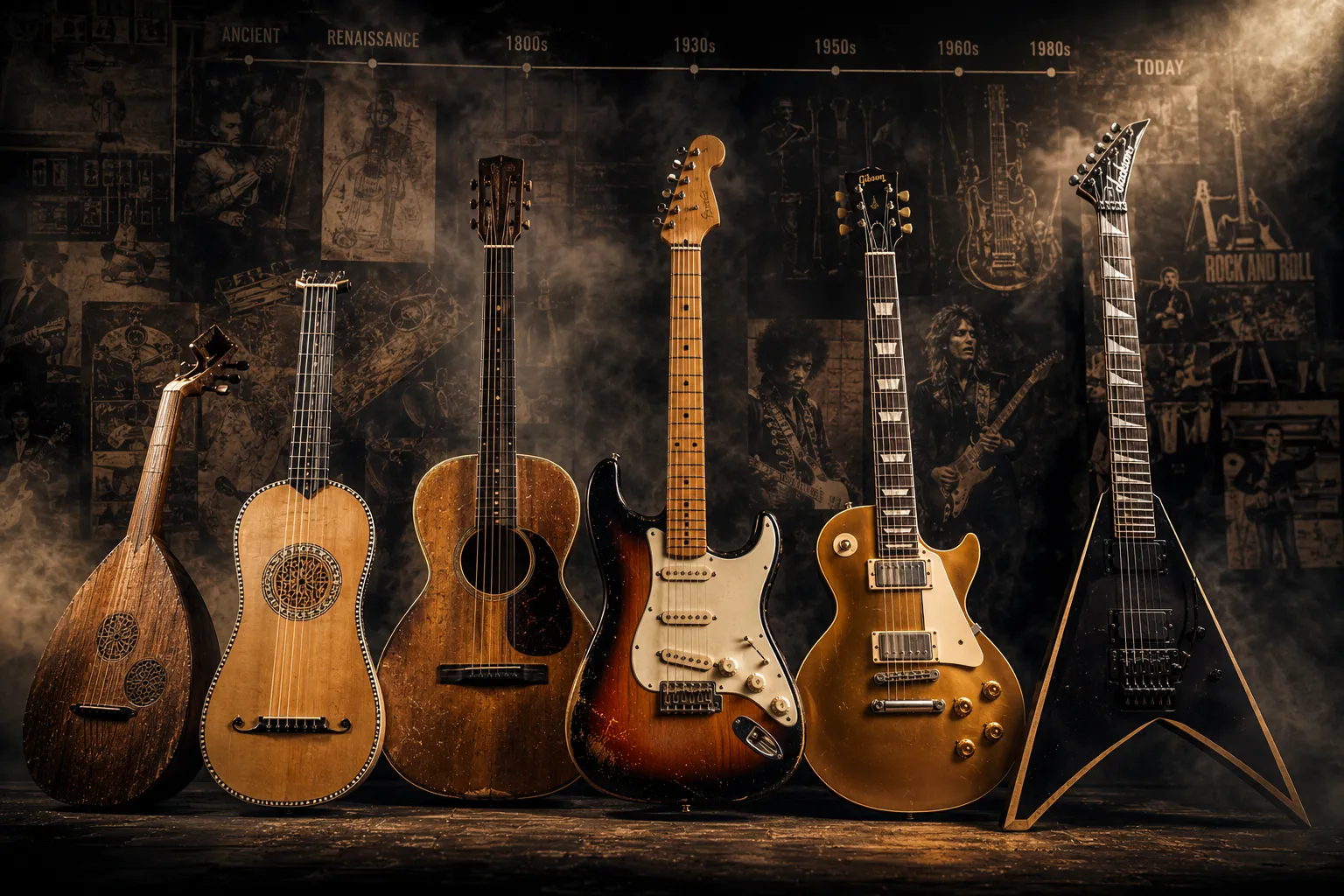
At roughly the same time, various forms of lutes emerged throughout Asia, North Africa, and the Mediterranean. These instruments were not guitars in the modern sense, but they established the fundamental idea of vibrating strings stretched over a resonating body — the basic principle behind every guitar ever built.
The Arrival of the Lute in Europe
During the Middle Ages, cultural exchanges between Europe and the Islamic world helped spread stringed instruments across the continent.
The Moorish occupation of Spain introduced the oud to European musicians. Over time, European craftsmen modified the instrument, adding frets and altering body shapes.
The result was the lute.
By the 14th and 15th centuries, the lute had become one of Europe's most important musical instruments. It was favored by royalty, composers, and traveling musicians alike.
Lutes featured rounded backs and multiple strings arranged in courses, allowing performers to play complex harmonies and melodies.
For several centuries, the lute dominated European music.
But another instrument was beginning to emerge.
The Birth of the Guitar
By the Renaissance period, smaller guitar-like instruments began appearing throughout Spain and Italy.
One of the earliest was the vihuela, a six-course instrument popular in Spain during the 16th century. Unlike the rounded lute, the vihuela featured a figure-eight body shape much closer to the modern guitar.
Around the same time, the four-course guitar gained popularity. These early guitars were relatively small and used primarily for accompaniment rather than solo performance. Still, they introduced many characteristics that would eventually define the instrument.
By the 17th century, the five-course Baroque guitar became widespread throughout Europe.
Composers began writing specifically for the instrument, and guitar techniques became increasingly sophisticated.
The guitar was no longer simply a folk instrument.
It was becoming a legitimate musical voice.
The Classical Guitar Emerges
The modern acoustic guitar began taking shape during the late 18th and early 19th centuries.
Instrument makers gradually moved from paired strings to single strings, creating a six-string format that remains standard today.
Spanish luthier Antonio de Torres Jurado is often credited as the father of the modern classical guitar.
In the mid-1800s, Torres dramatically redesigned the instrument. He enlarged the body, refined internal bracing patterns, improved resonance, and established many of the dimensions still used by guitar makers today.
His innovations transformed the guitar's volume, tone, and projection.
For the first time, the instrument could compete more effectively in concert settings.
The guitar had found its modern form.
The Guitar Arrives in America
As European immigrants settled throughout North America, they brought guitars with them.
The instrument quickly spread across the United States during the 19th century.
It became particularly popular among folk musicians, cowboys, traveling performers, and rural communities.
Unlike pianos or orchestral instruments, guitars were relatively affordable, portable, and easy to learn.
Their versatility made them ideal companions for everyday life.
By the late 1800s, companies such as Martin and Gibson began producing guitars commercially, laying the foundation for the modern guitar industry.
Blues and the Rise of the Steel-String Guitar
In the American South, the guitar found a new voice.
African American musicians blended work songs, spirituals, folk traditions, and field hollers into what would become the blues.
Artists such as Robert Johnson, Son House, Charley Patton, Blind Lemon Jefferson, and Lead Belly transformed the guitar into an intensely personal storytelling instrument.
Their fingerpicking styles, bottleneck slide techniques, and emotional performances created an entirely new musical language.
At the same time, manufacturers began experimenting with steel strings.
These produced greater volume and brightness than traditional gut strings.
Steel-string acoustic guitars quickly became favorites among blues, folk, country, and popular musicians.
The guitar was no longer merely accompanying songs.
It was becoming the star.
The Invention of the Electric Guitar
By the 1930s, musicians faced a growing problem.
Big bands and orchestras were becoming louder. Acoustic guitars often disappeared beneath brass sections and percussion.
Inventors began searching for ways to amplify string vibrations electronically.
The result was the electric guitar.
Early pioneers such as George Beauchamp, Adolph Rickenbacker, and Les Paul experimented with magnetic pickups capable of converting string vibrations into electrical signals.
The first commercially successful electric guitars appeared during the 1930s.
At first, they were primarily used in jazz.
But their impact would soon extend much further.
The Birth of Rock and Roll
The 1950s changed everything.
As rock and roll exploded across America, the electric guitar became its defining instrument.
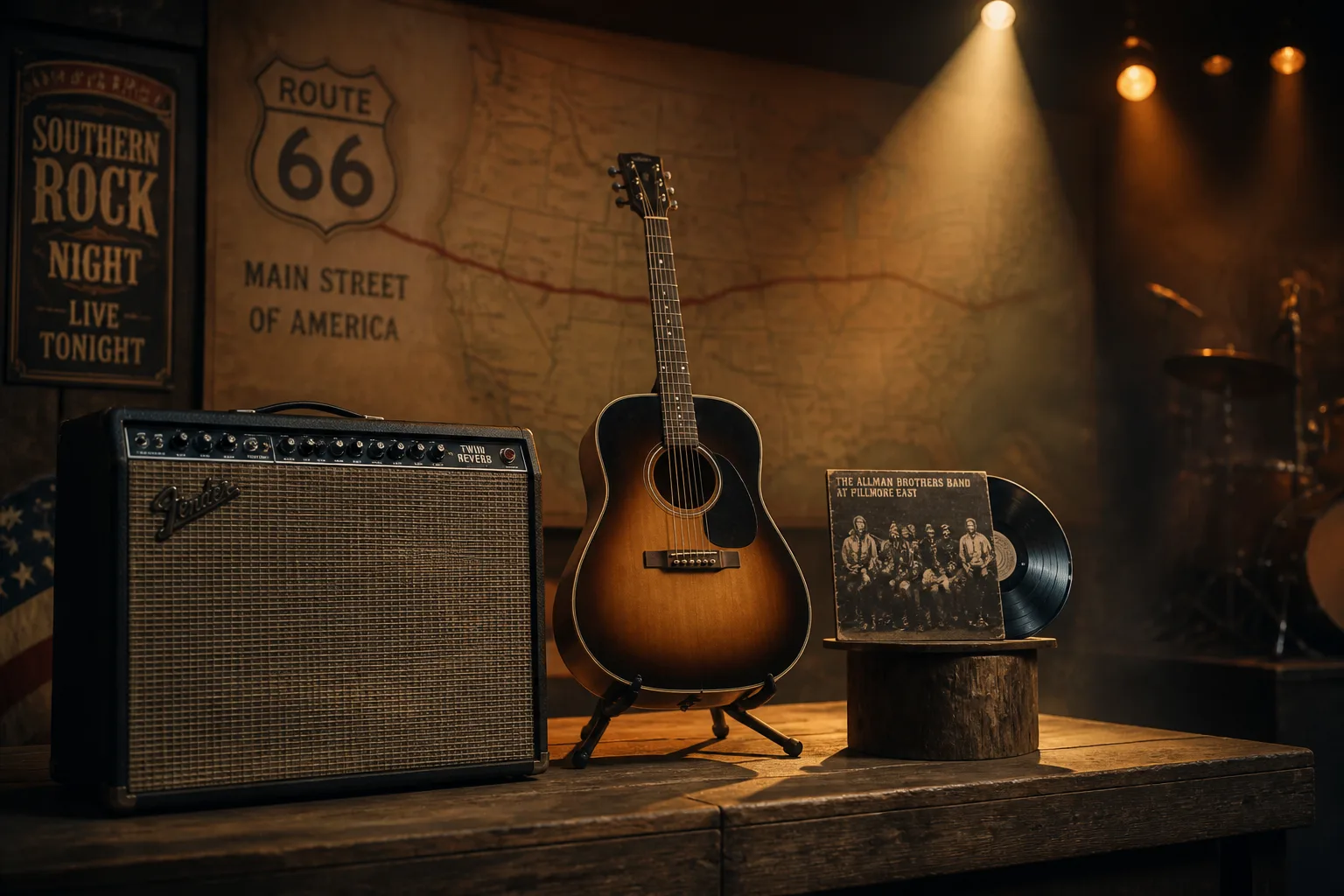
Players such as Chuck Berry, Buddy Holly, Bo Diddley, Carl Perkins, and Scotty Moore used amplified guitars to create a sound unlike anything audiences had heard before.
Then came Elvis Presley.
While Elvis himself was not primarily known as a guitarist, his rise helped place guitars at the center of youth culture worldwide.
Teenagers suddenly wanted guitars.
Manufacturers struggled to keep up with demand.
The instrument had become a cultural phenomenon.
The Golden Age of Guitar Heroes
The 1960s and 1970s are often considered the guitar's greatest era.
Virtuoso players emerged across nearly every genre.
Jimi Hendrix revolutionized electric guitar technique through feedback, distortion, wah pedals, and improvisation.
Eric Clapton helped define blues-rock.
Jimmy Page transformed hard rock through Led Zeppelin.
Jeff Beck, Pete Townshend, Carlos Santana, David Gilmour, Duane Allman, Ritchie Blackmore, Mark Knopfler, and countless others expanded what the instrument could achieve.
Meanwhile, folk musicians such as Bob Dylan, Joan Baez, Gordon Lightfoot, and Neil Young used acoustic guitars to soundtrack social and political movements.
The guitar became both a musical tool and a cultural symbol.
Metal, Punk, and Alternative Rock
The 1980s brought further evolution.
Heavy metal guitarists pushed speed and technical precision to new extremes.
Eddie Van Halen introduced revolutionary tapping techniques.
Randy Rhoads, Steve Vai, Joe Satriani, Zakk Wylde, and Yngwie Malmsteen elevated guitar virtuosity to astonishing levels.
At the same time, punk rock embraced simplicity and raw energy.
Bands proved that passion mattered more than technical perfection.
Later, alternative rock and grunge artists such as Kurt Cobain, Jerry Cantrell, Kim Thayil, Billy Corgan, and Tom Morello brought a new generation back to straightforward songwriting and emotional authenticity.
Throughout every shift, the guitar remained central.
The Guitar in Country, Jazz, and Beyond
While rock often dominates discussions about guitar history, many other genres helped shape the instrument's evolution.
Country pioneers such as Chet Atkins, Merle Travis, and Doc Watson developed intricate picking techniques that continue influencing players today.
Jazz legends such as Charlie Christian, Wes Montgomery, Joe Pass, Pat Metheny, and George Benson demonstrated that the guitar could be every bit as sophisticated as a piano or horn.
Flamenco players pushed rhythm and speed to extraordinary levels.
Classical performers expanded the instrument's repertoire through concert performances around the world.
Every genre left fingerprints on the guitar's development.
The Digital Era
The arrival of computers transformed guitar technology.
Digital effects processors, amp modeling software, recording plugins, impulse responses, and virtual studios changed how musicians created and distributed music.
Artists could now record professional-quality guitar tracks from bedrooms and home studios.
Platforms like YouTube accelerated learning.
Aspiring players gained access to lessons that previous generations could only dream about.
The guitar became more accessible than ever before.
At the same time, manufacturers embraced innovation through modeling guitars, MIDI systems, digital amplifiers, and software-driven production environments.
The instrument continued evolving while retaining its traditional roots.
The Guitar Today
Today the guitar exists in more forms than at any point in history.
Acoustic guitars remain staples of songwriting.
Electric guitars continue driving rock, blues, country, jazz, metal, indie, and alternative music.
Extended-range guitars, digital modeling systems, MIDI guitars, hybrid instruments, and AI-assisted production tools continue pushing boundaries.
While musical trends come and go, the guitar has shown remarkable resilience.
Few instruments offer the same combination of portability, versatility, expressiveness, and emotional connection.
For more than four centuries, musicians have used guitars to tell stories, express feelings, challenge conventions, and bring people together.
That journey began with simple strings stretched across wooden bodies thousands of years ago.
And it continues every time someone picks up a guitar and plays their very first note.
The guitar's history is not finished.
Every new player adds another chapter.