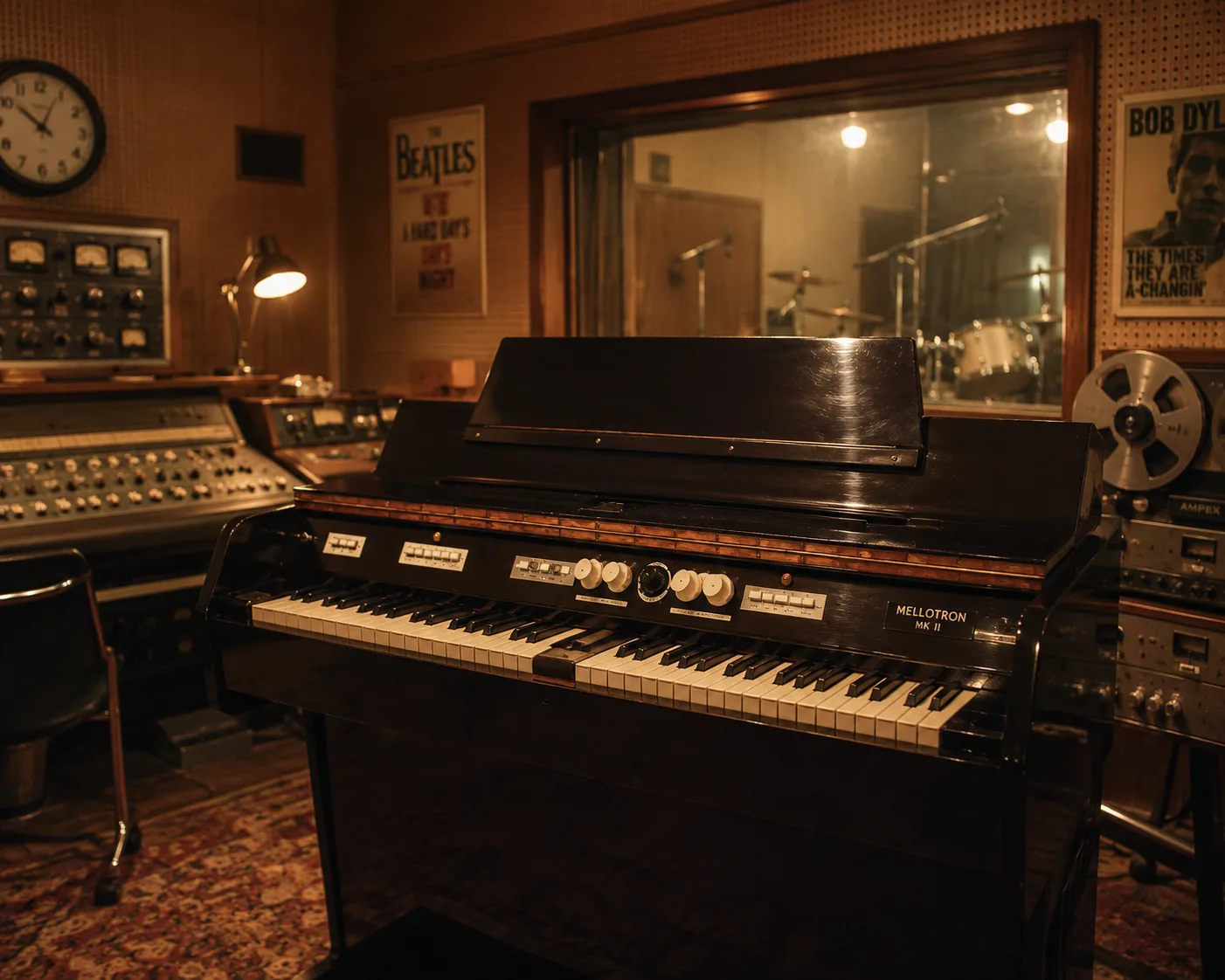
The History of the Mellotron: The Instrument That Changed Rock Music Forever
Long before digital samplers, virtual instruments, and modern synthesizers became commonplace, there was the Mellotron — a strange, groundbreaking keyboard instrument that gave musicians access to entire orchestras, choirs, and exotic sounds at the touch of a key. Often described as the world's first sampler, the Mellotron helped shape some of the most influential recordings in rock history and remains one of the most distinctive instruments ever created.
The origins of the Mellotron can be traced back to the 1940s with an instrument known as the Chamberlin. Invented by American engineer Harry Chamberlin, the machine used strips of magnetic tape to reproduce recordings of real instruments. Each key triggered a separate tape containing a recording of a violin, flute, choir, brass section, or other instrument.
The concept was revolutionary. Instead of synthesizing sounds electronically, the Chamberlin played back actual recordings. Musicians could suddenly access sounds that would otherwise require an entire ensemble of performers.
In the early 1960s, British entrepreneurs Frank, Norman, and Les Bradley acquired rights related to the technology and began developing what would become the Mellotron through their company, Streetly Electronics in Birmingham, England.
The first commercially successful model, the Mellotron Mark I, appeared in 1963. It was followed by the Mark II and eventually the legendary M400, which became the most famous version of the instrument.
At its core, the Mellotron was surprisingly mechanical. Every key on the keyboard had its own strip of magnetic tape. Pressing a key caused a tape head to play a pre-recorded sound. When the key was released, the tape rewound to its starting position, ready for the next note.
This design gave the instrument a unique character. Notes could only play for a limited duration before the tape ran out, typically around eight seconds. The mechanical nature of the system also introduced subtle imperfections, fluctuations, and pitch variations that became part of the Mellotron's signature sound.
While engineers often viewed these quirks as flaws, musicians embraced them as part of the instrument's charm.
The Mellotron first gained widespread attention in the mid-1960s. One of its earliest famous appearances came on The Beatles' 1967 single "Strawberry Fields Forever." The song opens with what many listeners assumed was a flute ensemble. In reality, it was a Mellotron flute sound played by Paul McCartney.
That haunting introduction instantly demonstrated the instrument's creative potential.
Following The Beatles' success, the Mellotron rapidly found its way into recording studios across Britain and beyond.
Few bands embraced the instrument more enthusiastically than King Crimson. Their 1969 debut album In the Court of the Crimson King featured massive Mellotron choir and string sounds that helped define progressive rock. The instrument became a cornerstone of the genre, appearing on countless recordings by Yes, Genesis, Moody Blues, Camel, Gentle Giant, and other progressive rock pioneers.
The Moody Blues were particularly influential in bringing the Mellotron into mainstream consciousness. Albums such as Days of Future Passed showcased lush orchestral textures that many listeners initially believed were produced by real symphony orchestras.
Genesis keyboardist Tony Banks became one of the instrument's greatest champions. Throughout the 1970s, his Mellotron strings and choirs provided the dramatic atmosphere that characterized many of the band's classic recordings.
The instrument also found fans outside progressive rock. David Bowie incorporated Mellotron sounds into several recordings. Led Zeppelin used the instrument in the studio. The Rolling Stones experimented with it. Even artists working in folk, psychedelic, and early electronic music embraced its distinctive sonic palette.
Despite its popularity, the Mellotron was notoriously unreliable. The machines were heavy, often weighing well over 100 pounds. Hundreds of tape strips could become tangled, stretched, or damaged. Touring musicians frequently encountered mechanical failures, temperature-related issues, and endless maintenance challenges.
Many keyboard players developed a love-hate relationship with the instrument. They adored its sound but dreaded transporting and repairing it.
By the late 1970s and early 1980s, advances in synthesizer technology began to threaten the Mellotron's dominance. Instruments such as the Yamaha CS-80, Sequential Circuits Prophet-5, and eventually the Fairlight CMI offered greater flexibility and reliability.
The arrival of affordable digital samplers accelerated the decline. For the first time, musicians could record and manipulate their own sounds without relying on mechanical tape systems.
As a result, the Mellotron largely disappeared from mainstream music during much of the 1980s.
Its story, however, was far from over.
The 1990s brought renewed interest in vintage instruments and classic recording techniques. Bands such as Oasis, Radiohead, Smashing Pumpkins, and Pearl Jam helped introduce Mellotron sounds to a new generation of listeners.
Progressive rock revivalists and indie artists embraced the instrument's nostalgic, cinematic qualities. What had once been considered outdated suddenly became desirable again.
Modern manufacturers eventually began producing updated versions of the Mellotron using digital technology while preserving the original sound libraries. Today's Mellotron instruments can contain thousands of samples while maintaining the character that made the original machines famous.
The instrument's influence extends far beyond rock music. Its concept directly anticipated modern sampling technology. Every software sampler, virtual instrument, and sample library owes a debt to the ideas pioneered by the Mellotron and Chamberlin decades ago.
Many historians consider the Mellotron one of the most important instruments ever developed because it fundamentally changed how musicians thought about sound. Instead of being limited to the instruments physically present in a studio, artists could suddenly access entire orchestras, choirs, and exotic textures from a keyboard.
Today, the Mellotron remains one of the most recognizable sounds in music history. Its haunting choirs, lush strings, and ethereal flutes continue to appear on recordings across genres. More than sixty years after its introduction, the instrument still evokes mystery, nostalgia, and imagination.
In an era dominated by software and artificial intelligence, the Mellotron stands as a reminder that some of music's most magical innovations came from a collection of tape loops, mechanical parts, and the simple dream of putting an orchestra at every musician's fingertips.